
What Are You Avoiding?
On addiction, invention, and the silence where transformation begins

Most of us are running from something. Not obviously, not dramatically but in the quiet choices we make each day about how to fill the space, dull the discomfort, or simply keep moving. I have been sitting with this question through the lens of the Gene Keys, and it has asked more of me than I expected.
From my time here on Substack, I feel most of us are on a personal development, transformational journey, wanting to become better, more heart-centred beings. Studying the Gene Keys is helping me look at things from different perspectives and be inventive in ways I probably wouldn’t have seen if I hadn’t learned to pause and contemplate. These are things that, in my earlier years, would never have entered my thought patterns, but they have probably brought about the biggest shifts.
Addiction
Addiction, to some extent, affects all of us. There are many expressions of addiction, and the ones we hear about most are alcohol and drugs, but they also include eating, gambling and sex. In fact, any learned conditioned pattern that we keep following throughout our lives, and that keeps us trapped within our comfort zone, can be seen as a form of addiction.
“All modes of thinking are addictive.” (Richard Rudd)
It’s not often we look at our addictive patterns and where they arise from, but we are all addicted to something.
All addiction is misidentification. We feel deep, intense emotions such as grief, boredom or hurt, and we want to avoid feeling that state, so we find a pattern of behaviour that can temporarily mask the discomfort. We start to turn to this behaviour at any hint of the unwanted emotion, but as the masking is not permanent we reach for the comforting behaviour more and more.
Addiction falls into two types: those that numb and those that stimulate. It is the stimulating addictions that we are most familiar with.
There are two major forces in the world: gravity and levity, and we are caught in a dance between the two. Gravitational forces keep us feeling heavy, trapped and distressed, trying to avoid feeling something. That avoidance just adds to the heaviness. We lie to ourselves, which leads to more guilt, shame and rage, and this can create an endless cycle of being trapped in addiction.
Richard suggests it is our addictive patterns that advertising agencies take full advantage of.
In comparison, levity patterns lift us and give us hope and feelings of vitality and visions of what is possible in life, giving us a sense of purpose.
The first step to get out of addiction is part of twelve-step programmes like Alcoholics Anonymous is honesty: admitting the position you are in.
“What do you do to prevent yourself from enjoying pauses? What do you do that causes you to miss out on the finer things of life?” (Richard Rudd)
Part of me wants to say I don’t have any addictive tendencies. I’ve never been drawn to drink, smoke or comfort eat excessively. But there are loads of other, more subtly hidden addictions, mostly in the numbing category, if I look deeply and honestly enough. Keeping busy is probably my most obvious distraction, and disappearing into a good book for hours on end means I ignore other things that probably should be a priority. I’m also pondering whether my daily walks, though essential for my well-being, are also a subtle form of addiction. I certainly crave one if I haven’t been out, and if I’m in a city for any length of time I start craving nature and the green hills around where I live.
I’m sitting with the question: what is the difference between an addiction and a good habit? Possibly, addiction pulls me down and keeps me stuck, while a good habit is a gift that lifts me up. So I feel it is the energy behind it that is the difference between a shadow and a gift.
Richard explains that turning to any of the Siddhis is step two, as they remind us of our true purpose.
“The Siddhi is the levity, as gravity is the shadow.” (Richard Rudd)
When we contemplate the gravity of the shadow and the beauty and freedom of the Siddhi, the gift will naturally come into play.
Invention
Invention is creativity in action that can pull us out of gravity and towards levity.
In the I Ching it is called “The Return”, and it is about going back to the roots so we can change the pattern.
“Sow a thought, reap an action.
Sow an action, reap a habit.
Sow a habit, reap a character.
Sow a character, reap a destiny.”
(Chinese proverb)
Learning to sit and contemplate has been quite a challenge for me, as I would, surprise, surprise prefer to be doing. But I have reaped many benefits from doing so. It lets things emerge at their own pace, with no pushing, and they are far more transformational in the long term.
“Invention is not something you do; it’s something that happens and wells up from the unknown.” (Richard Rudd)
Invention is a mystery. Richard suggests it is creative addiction. It comes from a Siddhi and is able to reshape your life from the inside out. But first you must be listening and willing to see the shadow for what it is.
“The human act of pondering might be an apt description for what occurs through this Gift.” (Richard Rudd)
Silence
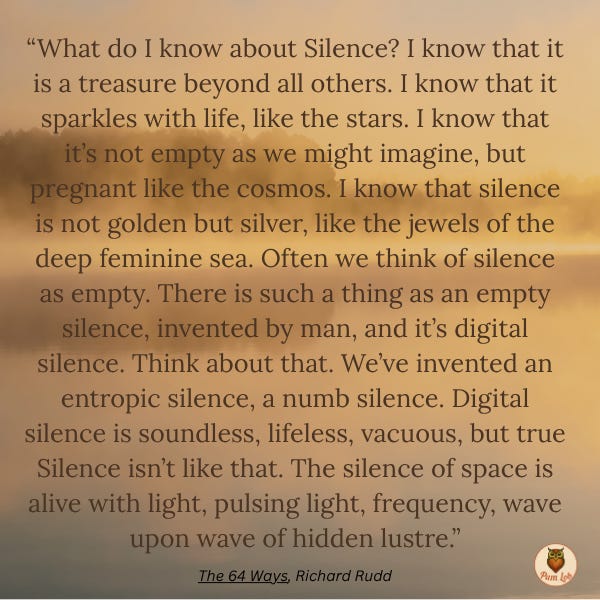
Silence is not empty, except for digital silence, invented by humans that is numb, soundless and lifeless. True silence is alive with light and possibility. We never know what could emerge from it.
“Silence is the natural background state of all human awareness, and silence can only occur when thinking ceases entirely.” (Richard Rudd)
Silence is the one I find hardest to embrace. I still often fill it with doing, with purpose. But the moments when I have genuinely stopped and let it settle have been the ones that changed something. I am learning that silence is not absence. It is where the answer was waiting.
I know this because it happened while writing this very article.
I had most of it drafted and settled down to sleep, my mind turning over what I had written and drifting towards the Gaea Remembered series. I noticed something: when I write the books, the words simply bubble up and spill out through my fingers onto the keyboard. My mind is relatively quiet. Writing these articles is different, more of a mind exercise. Should I say this? What does Richard mean by that? And then, somewhere in that noticing, words began arriving for this section. Not thought out. Just arriving.
I was writing in bed on my iPad in airplane mode. If I don’t get the words down they just repeat on a loop and I won’t sleep.
Why does this happen in bed? There is silence. A pause. The day has stopped asking things of me.
When I sit down to write my book I pause first and drop into something close to a meditative state. Once I am in that place I can often write for an hour or more without surfacing. I am realising I need to do the same when I write these articles. The mind exercise has its place, but the words that arrive through silence are the ones worth keeping.
In Daughter of the Solstice, Monia enters a world that still knows how to be still. The tradition she is learning begins not with action but with listening. I think that is part of why I am writing it.
If you are new to the Gene Keys, here is my introduction: The Long-Locked Room: An Introduction to the Gene Keys.
What is your most honest addiction — the one you would rather not name?
Ok an honest addiction. Messing with acne and skin bumps. Leave it. Have to peel my mind away. Once separated, the addiction is gone. Like a Reverie takes over. Smack myself haha
Freedom is a great gift from beating addiction and realizing how trapped we were. It is often felt the first time someone else is engaging in the behavior (like smoking, I quit). The lightness of not Having to join in can be bodily felt on occasion. I feel that way with my attention. ADHD has its effect, but I don’t define myself by it. The way we face labels reveals addictive patterns also.